

What Is a CCTV DVR? A Complete Guide to Understanding and Buying a CCTV DVR
A CCTV DVR (Digital Video Recorder) is the heart of every modern analog surveillance system. This device is not just an ordinary video recorder; it acts as the central brain that receives analog video signals from the security cameras, processes them, converts them into digital format and stores them securely on a hard disk.
The Digital Video Recorder plays a crucial role, because without it, CCTV cameras would only capture images, with no ability to store footage, monitor remotely or play back important events needed for security or forensic purposes. That is why understanding the functions and types of DVR is an essential first step before building an effective and reliable security system.
Definition of a CCTV DVR
DVR is an acronym for Digital Video Recorder. In the context of surveillance systems, a CCTV DVR can be defined as the main piece of hardware that acts as a bridge between analog security cameras (traditional cameras) and digital storage media.
This device has a fundamental function in a CCTV system. Essentially, analog CCTV cameras only produce a video signal in analog format. This signal cannot be processed or stored directly by a computer or modern digital media. This is where the DVR plays its crucial role:
- Analog Signal Acquisition
The DVR receives the raw video signal transmitted over coaxial cable from the connected analog cameras. - Conversion
The DVR is equipped with an internal chipset or processor that instantly converts the continuous analog signal into digital data (a series of 0 and 1 bits). - Processing and Compression
This digital data is then processed and compressed using an encoding standard (such as H.264 or H.265) to reduce the file size without significantly sacrificing quality. This compression step is very important for saving storage space on the hard drive. - Digital Storage
After compression, the data is sent to and stored on the internal Hard Disk Drive (HDD) installed in the DVR unit.
So a DVR does not just work as a "recording device"; it is also a signal converter and data manager that makes sure high-resolution video footage can be archived, accessed and played back whenever it is needed.
Read also: What Is a CCTV NVR? A Complete Guide to the Latest Security Technology
The Main Functions and Roles of a CCTV DVR
As the core component of a surveillance system, a CCTV DVR has several multidimensional functions that go beyond simply recording. These roles make sure the security system works efficiently, is easy to access and provides credible data.
a. Recording and Storage
This is the primary and most basic function of a DVR. The DVR's job is to receive and continuously record the video feed from all connected cameras (through its input channels) and store it on digital media.
- Storage Media
A DVR uses a high-capacity internal Hard Disk Drive (HDD) as its main storage. - Purpose
It allows video footage to be kept for a set period (for example 7 days, 30 days or longer), depending on the HDD capacity and recording quality settings, which makes it important evidence if an incident occurs.
b. Signal Conversion & Compression
This function is the core of DVR technology and what sets it apart from old analog video recorders.
- How Conversion Works
As explained earlier, the DVR receives the analog signal from the camera, which is then converted into digital data. - Data Compression
After conversion, the DVR applies a data compression algorithm, such as the H.264 format or the more efficient H.265. This compression process is very important because it brings:- Storage Efficiency
It drastically reduces the size of video files, so footage can be kept for longer without needing an oversized HDD. - Transmission Efficiency
It makes it easier to transmit video data over the internet when remote access is enabled.
- Storage Efficiency
c. Remote Monitoring (Remote Access)
In a modern security system, the DVR acts as a server that supports real-time monitoring from anywhere in the world.
- Connectivity
The DVR is connected to the internet (through its LAN/Ethernet port). - Access
Users can access the live video feed (real-time monitoring) as well as stored footage through other devices, such as:- A dedicated smartphone app (Android/iOS).
- Software on a PC or laptop.
- Role
This function is very important for users who want to keep an eye on their property, office or business without having to be on site.
d. Playback and Quick Search
A DVR has advanced capabilities for managing large amounts of video data, which makes footage easy to review.
- Playback
This lets users review older footage from a specific time. - Advanced Search
A DVR lets users search footage by specific criteria, including:- Date and Time
Finding footage from a specific hour or day. - Motion Detection
The DVR only saves and flags footage when motion is detected, which speeds up the forensic process (incident review) and eliminates the time wasted watching empty footage. - Other Event Types
Such as missing objects, line crossing or face detection (depending on the DVR's features).
- Date and Time
e. Recording Quality Control
A DVR gives users full control over video quality settings to suit their needs and storage budget.
- Resolution Control
Users can set the recording resolution (for example 720p, 1080p, 4MP, up to 8MP). The higher the resolution, the more detailed the image, but the more storage space it needs. - Frame Rate (FPS)
A DVR lets you set the number of frames per second (FPS). A higher setting (for example 30 FPS) produces smoother motion (important for recording fast movement), while a lower setting (for example 15 FPS) can balance image quality against storage efficiency for long-term surveillance.
Types of CCTV DVR
As experts in security systems, we stress the importance of choosing the right type of DVR, a view that reflects our experience with installations at many different sites. In general, there are three main types of CCTV DVR on the market:
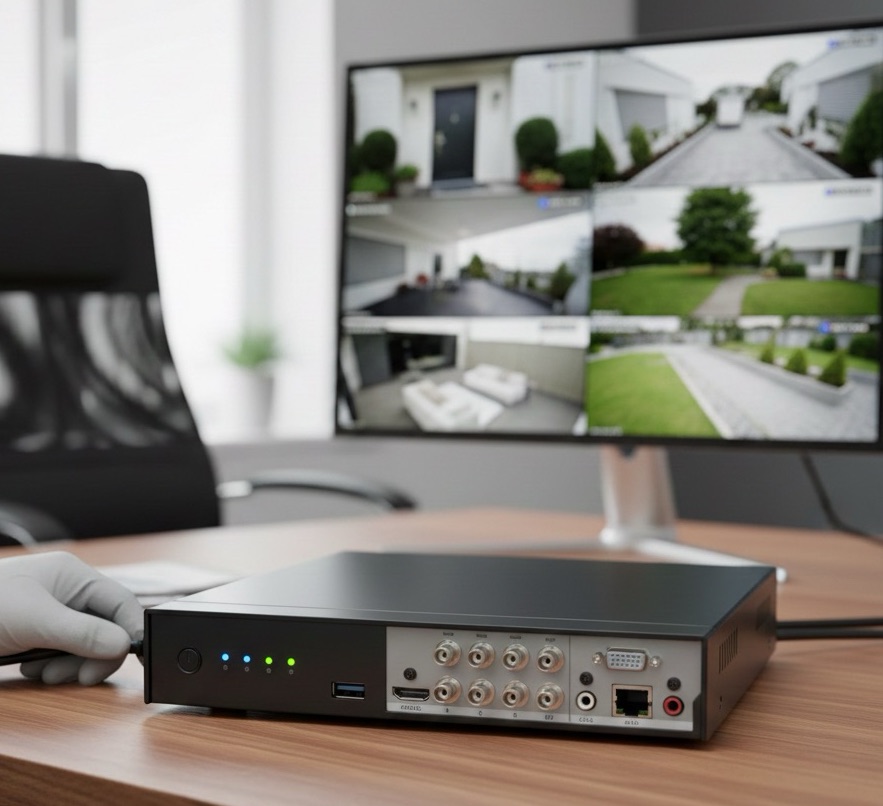
1. Standalone DVR
This is the most commonly used type. The device is built to process recording data around the clock, 24 hours a day for 7 days straight, without you having to worry about it overheating. It is compact, easy to set up and relatively cheap.
The catch, however, comes from the very fact that it is compact, easy to set up and needs no other equipment: if this DVR breaks down, you have to replace it with a new unit. It is also hard to integrate with other technology because it is a self-contained unit, which makes updating the firmware difficult as well.
If you want convenience and durability and do not need other features to support the system, a standalone DVR can be the right choice. It is a favorite with many people because it is durable, easy to install and does not need routine maintenance.
The unit is designed as a single piece of hardware that operates independently, powered by a dedicated embedded operating system, so it is known for being easy to install and operate without in-depth IT knowledge. Its operational reliability and stability make this type the right choice for small to medium-scale security solutions.
2. PC-Based DVR
This type uses a computer as its main platform, with a video capture card installed together with dedicated recording software. A PCI-based DVR usually comes in the form of a card. The PCI/PCIe card is installed inside a computer so the DVR can run and work properly. The DVR card itself is fairly cheap. However, once you add everything up, it ends up costing more because it needs a computer to run.
You will need a PCI-based DVR if you want to build a complex security system that can be integrated with other systems, for example with applications used by a company.
The advantages of a PCI-based DVR are that the hardware is easy to upgrade, it has plenty of features, it is more flexible, and it can be integrated with other applications.
Although it offers greater flexibility in terms of upgrades and customization, this type requires a higher level of technical skill to install and maintain, which makes it a choice for those with technical expertise.
3. Hybrid DVR (HDCVI, HDTVI, AHD, CVBS)
This type is an important innovation that shows how DVR technology keeps adapting. A hybrid DVR lets you connect traditional analog cameras (CVBS) and, most importantly, accommodates modern high-definition (HD) analog cameras such as HDCVI, HDTVI and AHD. This capability keeps your investment in a security system sound and relevant, because you can combine older cameras with the latest HD cameras to get sharper images without having to replace your entire cabling infrastructure.
Your choice of DVR type should be based on your specific needs, the level of complexity and your plans for expanding the surveillance system in the future.
Read also: The Differences Between DVR and NVR and Their Pros and Cons in CCTV
What to Consider When Choosing a CCTV DVR
Based on our many years of experience installing and maintaining surveillance systems, choosing the wrong DVR can undermine the effectiveness of your entire security system. Pay attention to these four important factors:
1. Number of Channels
This is the first consideration. Choose a DVR with enough input channels (for example 4, 8, 16 or 32) not only for the number of cameras you have now, but also with room left for possible expansion in the future.
Example: If you have 4 cameras installed at home, do not just choose a 4-channel DVR. Choose an 8-channel DVR so you can add 3 more cameras (7 in total) in the future without having to replace the DVR unit.
2. Hard Drive Capacity (Storage)
HDD capacity is key. You need to be able to work out how much storage you need. Simply put, the higher the resolution and the longer the recording period you want (for example, recording 24/7 for 30 days), the more HDD capacity you will need. Do not compromise on this, because your recorded data is your main asset.
Example: Recording 8 cameras at 1080p needs a 2TB HDD to store about 7 days of footage. If you want to keep 30 days, you need to increase the capacity to at least 8TB.
3. Maximum Supported Resolution
For a hybrid DVR, make sure the device you choose can support the highest camera resolution you use (such as 5MP or even 8MP 4K). If your DVR only supports 2MP, the image quality from your 5MP cameras will never reach its full potential.
Example: You have just bought a 5MP camera. Your DVR's specifications must say "Supports input up to 5MP" or higher. Otherwise, your 5MP images will be "downscaled" to 2MP, and you will lose important detail.
4. Additional Features and Smart Analytics
Modern DVRs offer features that add functional value. Look for features such as Motion Detection to save storage space, Cloud Backup support for data redundancy, and smart analytics features (such as a virtual tripwire) that can notify you of security threats proactively, not just reactively.
Weighing these factors will make sure your CCTV DVR system works at its best and is future-proof.
Why Buy a CCTV DVR from Gelora Perkasa?
At Gelora Perkasa, we supply a wide range of top-quality CCTV DVR types and models. We understand that every customer has different needs, which is why we offer a range of options that can be matched to your specific requirements.
- Quality Products:
We only sell top-quality, trusted products. - Customer Service:
Our customer service team is ready to help you choose the right DVR and answer any questions you have. - Professional Installation:
We offer professional installation services to make sure your security system works at its best. - Competitive Prices:
We offer competitive prices with high added value.
Read also: CCTV in Bali: Store Recommendations and CCTV Price Information
A CCTV DVR is an important component of a modern security system that lets you record, monitor and play back video footage from your security cameras. With so many types and features available, it is important to choose a DVR that suits your needs. At Gelora Perkasa, we are ready to help you choose and install the right CCTV DVR to secure your property.
If you still have questions or need more information, feel free to contact our customer service via the WhatsApp number below. We are ready to help!
Frequently Asked Questions
1. What is a CCTV DVR?
CCTV DVR stands for Digital Video Recorder for Closed-Circuit Television. It is a device used to record and store video footage from CCTV cameras. A DVR allows monitoring, recording and playback of video footage, both live and later.
2. What is the main function of a CCTV DVR?
The main function of a CCTV DVR is to record video from CCTV cameras onto digital storage media such as a hard drive. In addition, a DVR lets you adjust recording quality, monitor live, play back footage and use motion detection, which only records when motion is detected.
3. What types of CCTV DVR are available?
There are several types of CCTV DVR available, including:
Standalone DVR: Works independently and is easy to install.
PC-Based DVR: Uses a computer as its platform, is more flexible and can be upgraded.
Hybrid DVR: Works with both analog and IP cameras, ideal for systems with a mix of cameras.
4. What are the advantages of a CCTV DVR over other recording methods?
The advantages of a CCTV DVR include better data security thanks to digital storage, remote access over the internet, higher recording quality, and the ease of searching footage by date, time or specific events such as motion detection.
5. How do you choose the right CCTV DVR?
To choose the right CCTV DVR, consider factors such as a number of channels that matches your number of cameras, enough storage capacity, high recording resolution, compatibility with the type of cameras you have, and additional features such as motion detection and remote access.
